


LaGiB - Lacan Gruppe in Berlin - lädt herzlich ein:
Liebe Freundinnen, Freunde und Interessierte,
unsere „Lacan-Gruppe in Berlin“ (LaGiB – https:www.LaGiB.de – seit 1988 – zuvor als „Gruppe Köln-Paris“) lädt wieder herzlich ein zum Vortrag & gemeinsamen Austausch mit Aner Govrin, Kulturwissenschaftler, klinischer Psychologe und Psychoanalytiker aus Tel Aviv.
Zeit und Ort:
FREITAG, 9. November 2018, um 18:00 Uhr (Unkostenbeitrag 5 €)
Praxis Arndt Himmelreich, Haderslebener Str. 21 d, 12163 Berlin-Steglitz
(bei Fragen vorab, zur Barrierefreiheit, bei Verspätungen: 0173-725 12 41)
(Nähe Botanischer Garten/ Gustav-Mahler-Platz: U3 Breitenbachplatz; S1 und U9 Rathaus Steglitz; Bus 101 und N3 Rohlfsstraße, Bus X83 Schmidt-Ott-Str. bzw. Botanischer Garten; Bus 282 Paulsenstr. – Skizzen zum Auffinden der Praxis mit ihrem Vorder- sowie ihrem Garten-Eingang (zur 2. von unseren 4 Etagen), Informationen zur Barrierefreiheit und zu Parkplätzen am Ende dieser Einladung)
Wir freuen uns sehr darüber, dass der israelische Kulturwissenschaftler, klinische Psychologe und Psychoanalytiker Aner Govrin aus Tel Aviv zu uns angereist kommt und uns das folgende Thema vorstellt:
„Psychoanalytic Controversies”
(Vortrag in englischer Sprache – Dr. Aner Govrin spricht ein sehr leicht verständliches Englisch, klar & deutlich, langsam & ruhig)
Aner Govrin, Ph.D., is a clinical psychologist, psychoanalyst and the director of academic doctoral program "Psychoanalysis and Hermeneutics" at The Department of Hermeneutics and Culture at Bar Ilan University, Ramat-Gan, Israel. Dr. Govrin is in private practice of psychotherapy and psychoanalysis in Tel Aviv. He is a member of the Tel Aviv Institute for Contemporary Psychoanalysis (TAICP). http://culture.biu.ac.il/en
Aner Govrin ist Autor der Bücher:
-
•„Conservative and Radical Perspectives on Psychoanalytic Knowledge: The Fascinated and the Disenchanted“ (Routledge, 2016)
(nominated to American Board and Academy of Psychoanalysis Book Award – Vortrag von Aner Govrin bei LaGiB im Jahre 2016 zu diesem Buch) -
-
sowie des 2019 bei Routledge erscheinenden Buches:
-
-
-
-
•dazu sein frei zugänglicher Aufsatz hier: “The Cognition of Severe Moral Failure: A Novel Approach to the Perception of Evil” -https://www.frontiersin.org/articles/10.3389/fpsyg.2018.00557/full
Hier unten folgen noch der Abstract zu seinem Vortrag sowie andere Informationen.
Über eine kurze Rückmeldung/ Anmeldung würden wir uns sehr freuen!
(Mobil: 0173-725 12 41 oder info@lagib.de)
Herzliche Grüße
Arndt Himmelreich, Berlin (Arndt.Himmelreich@gmx.de) & Andreas Hammer, Köln & Tel Aviv (praxis@andreashammer.com)
Abstract:
Controversies of one kind or another have been with us since psychoanalysis’s inception. From the discipline’s earliest days, there were memorable disagreements between Freud and Joseph Breuer, as well as a range of disputes between Freud and Carl Jung, Alfred Adler, Otto Rank, and Sándor Ferenczi. After Freud’s death, there developed the historically famous disagreements between Melanie Klein and Anna Freud, between Karen Horney and the New York Psychoanalytic Institute, and between Jacques Lacan and the International Psychoanalytical Association.
Psychoanalytic controversies, particularly up until the 1980s, were highly charged, emotional, and characterized by hostility, tension, and an air of competitiveness. How are we to explain the contempt and lack of esteem that characterizes the attitude of some communities toward other communities similarly fascinated by a theory?
Why is the appearance of competing camps and the demand for loyalty so widespread in the psychoanalytic world? If the analyst sees many good reasons for his fascination - such as the fact that it is helpful to his patients - why is he troubled that other members of the community are fascinated by other theories with different assumptions about man’s psyche and the objectives of the therapy?
In this lecture I will try to answer these questions through two areas of disagreement within psychoanalysis: the controversial discussions in the British Society surrounding the differing views of Melanie Klein and Anna Freud (1942-1944), and the debate relating to the relevance of infant research to therapeutic processes.
Publications (in English):
1. Govrin, A. (2007). Conversations with Michael Eigen, London: Karnac.
2. Govrin, A. (2016). Conservative and Radical Perspectives on Psychoanalytic Knowledge: The Fascinated and the Disenchanted, London: Routledge.
3. Govrin, A. (2019 – wird in Kürze veröffentlicht). Ethics and Attachment: How We Make Moral Judgements, London: Routledge.
Articles (in English):
1. Govrin, A. (2004). Utilitarian sources in Freud’s early writings, Psychoanalysis and History, 6(1):5-21.
2. Govrin, A. (2006). The Dilemma of Contemporary Psychoanalysis: Towards a “Knowing” Post-Postmodernism, JAPA, 54, 2:507-536.
3. Govrin, A. (2006). When the underdog schema dominates the we-ness schema: The case of radical leftist Jewish – Israeli, The Psychoanalytic Review, 93, 4:623-654.
4. Govrin, A. (2007). The area of faith between Michael Eigen and his readers, Journal of Health and Religion, Quadrant Journal of the C. G. Jung Foundation for Analytical Psychology, XXXVII: 1 Winter, 9-27.
5. Govrin, A. (2011). Forget the Palestinians, You Are Our Mother – Why Therapists Should Not Be Dead Right With Their Patients? Psychoanalytic Perspectives, 8:215-22.
6. Govrin, A. (2014). The ABC of Moral Development – An Attachment Approach to Moral Judgment, Frontiers in Psychology, 5:6, pp. 1-14.
7. Govrin, A. (2014). The Vices and Virtues of Monolithic Thought in the Evolution of Psychotherapy, Journal of Psychotherapy Integration, 33pp. With Commentary by Paul Wachtel, Society for the Exploration of Psychotherapy Integration (SEPI), Giancarlo Dimaggio, M.D., Center for Metacognitive Interpersonal Therapy, Rome & Paul H. Lysaker, Ph.D., Giancarlo Dimaggio M.D., Center for Metacognitive Interpersonal Therapy, Rome & Paul H. Lysaker, Ph.D.
8. Shahar, G. & Govrin, A. (2017). Psychodynamizing and Existentializing Cognitive-Behavioral Interventions: The Case of Behavioral Activation (BA). Psychotherapy, Vol. 54(3), Sept. 2017, 267-272 (http://dx.doi.org/10.1037/pst0000115).
9. Govrin, A. (2018). The Cognition of Severe Moral Failure: A Novel Approach to the Perception of Evil, Frontiers in Psychology, 9:557 (https://doi.org/10.3389/fpsyg.2018.00557).
Book Chapters (in English):
1. Govrin, A. (2015). The Explosion is Over! Continue with Free Associations. Psychoanalysis in Israel and the Ongoing Threat, In: Spero, M. (Ed.). The Transmission of Passion: Practicing Psychoanalysis within and Beyond the Borders of the Land of Israel, Academic Studies Press. (33 pp).
2. Govrin, A. (2015). On Supervision With Michael Eigen - In: Bloch, S. & Daws, L. (Eds.). The Living Moments – On the work of Michael Eigen, Karnac. (36 pp).
3. Govrin, A. (2016). The Psychology of evil, In: Mills, J. and Nasso, R. (Eds.). Ethics of Evil – Psychoanalytic Investigations, Ch. 3: 95-134, London: Karnac.
Wegbeschreibung:
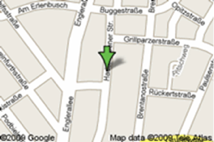

(1) Unsere Praxis liegt etwas von der Straße entfernt, darum oben die Skizzen.
Tipp: Wenn jemand von der Brentanostraße kommt – von „Rathaus Steglitz“ bzw. der Haltestelle „Schmidt-Ott-Str.“ – kann er auch obigen kleinen Fußgänger- und Radweg (mittlerweile leider ohne Ausschilderung versteckt zwischen den Häusern), also die Fußgänger-Verlängerung der Rückertstraße als Abkürzung nutzen.
(2) Kostenlose Parkplätze gibt es überall an unserer Ecke „Haderslebener Str./ Gustav-Mahler-Platz“, der übrigens gar kein Platz, sondern ein Park mit Teich ist…
-
(3)Der Zugang zur Praxis ist nicht ganz barrierefrei: die 8 Treppenstufen auf der Privat-Parkplatz-/ Straßen-/ Garten-Eingangs-Seite („P“ oben auf der rechten Skizze) waren bisher aber immer leicht zu erklimmen! Wir helfen gerne, bitte bei Ankunft obige Mobilnummer anrufen!